A new windshield can look perfect and still leave a safety system out of alignment. Windshield calibration is the step that helps your vehicle’s driver-assistance cameras and sensors see the road correctly after a windshield replacement or certain glass repairs. For drivers around Humble and Harris County, it is not an optional technical detail. It is part of restoring the vehicle to the safe, reliable condition you expect.
Many newer vehicles place a forward-facing camera behind the windshield near the rearview mirror. That camera supports features such as lane departure warnings, lane-keeping assistance, automatic emergency braking, forward collision alerts, adaptive cruise control, and traffic sign recognition. When the windshield changes position, even slightly, the camera’s view can change with it. Calibration tells the vehicle where that camera is now and allows its safety features to operate as intended.
What Is Windshield Calibration?
Windshield calibration is a precise procedure used to reset and verify an Advanced Driver Assistance System, commonly called ADAS. The technician connects professional diagnostic equipment to the vehicle and follows manufacturer-specific procedures to align the camera or sensor system after windshield work.
This is not the same as simply clearing a dashboard warning light. A proper calibration confirms that the system recognizes its reference points and can accurately interpret lane markings, vehicles ahead, road edges, and other information it relies on while you drive.
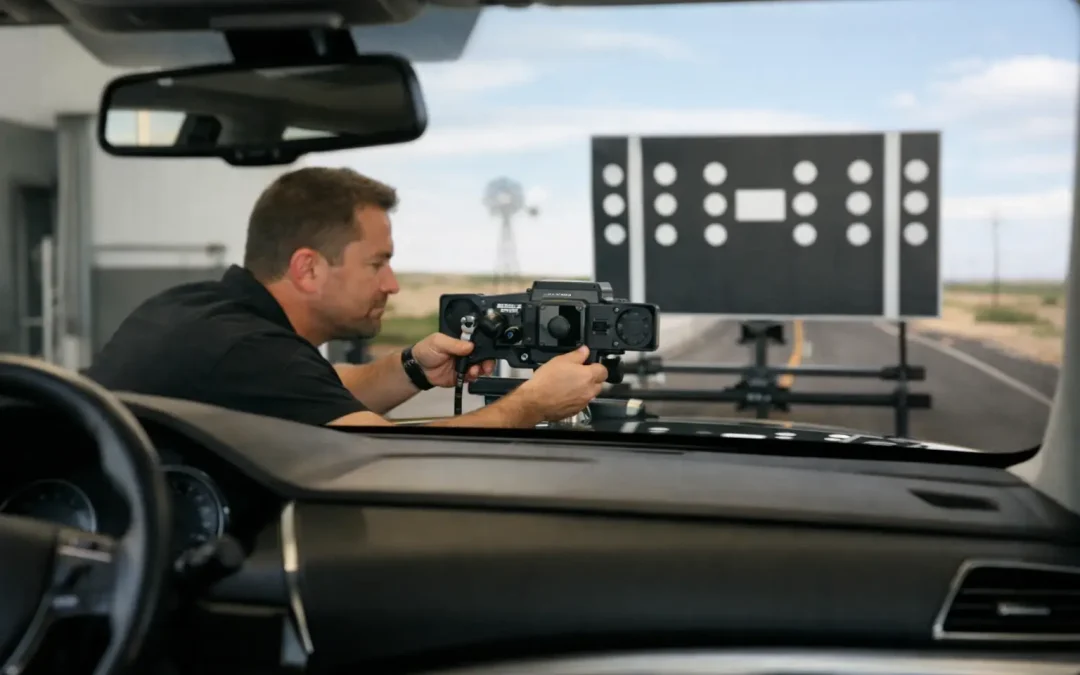
The exact process depends on the make, model, year, and equipment on your vehicle. Some vehicles require static calibration in a controlled setting using measured targets and specialized equipment. Others require dynamic calibration, which is completed during a carefully driven road procedure under the right conditions. Some need both.
That difference matters. The correct procedure is determined by the vehicle manufacturer’s requirements, not by what happens to be quickest on the day of service.
Why a Windshield Replacement Can Affect ADAS
Your windshield is more than a piece of protective glass. On an ADAS-equipped vehicle, it is also part of the camera’s operating environment. The camera bracket, glass shape, optical clarity, mounting position, and the angle of the windshield can all affect what the system sees.
A replacement windshield may have the same general fit as the original, but a very small change in camera position can affect the camera’s view of the road. Adhesive curing, proper installation, correct moldings, and accurate camera reinstallation all play a role. This is why quality glass work and calibration should be treated as connected services rather than separate concerns.
For example, a lane-keeping feature that interprets lane lines too early or too late may respond inconsistently. A forward collision system could calculate distance or speed differently than intended. You may not notice a problem on every drive, which is exactly why relying on a warning light alone is not enough.
When Does Your Vehicle Need Calibration?
Calibration is commonly required after a windshield replacement when the vehicle has a forward-facing ADAS camera. It may also be needed after camera removal, collision damage, suspension or alignment work, certain bumper repairs, or diagnostic trouble codes related to driver-assistance systems.
Do not assume every vehicle needs the same service. A basic windshield replacement on an older vehicle without camera-based safety features may not require calibration. On the other hand, many late-model cars, trucks, SUVs, and crossovers do require it, even if the safety features are not used often.
If you are unsure whether your vehicle has ADAS, look near the rearview mirror for a camera housing or ask about features such as automatic braking, lane assistance, adaptive cruise control, or forward collision alerts. A qualified auto glass professional can also verify the vehicle’s requirements before work begins.
Static vs. Dynamic Calibration
Static calibration is performed with the vehicle positioned on a level surface. The technician places manufacturer-specified targets at exact distances and heights from the vehicle, then uses diagnostic equipment to guide the camera through its learning process. The setup has to be accurate. A few inches of error can defeat the purpose of precision calibration.
Dynamic calibration is completed while driving the vehicle under specified conditions. The system may need to see well-marked lanes, travel at certain speeds, and operate in suitable weather and lighting. Houston-area traffic, road construction, heavy rain, and faded lane markings can affect how easily this procedure can be completed.
There is a practical trade-off here. Dynamic calibration can sound simple because it involves driving, but it is not a casual test drive. Static calibration requires dedicated equipment and a controlled environment, while dynamic calibration requires appropriate road conditions. The right method depends on what the manufacturer calls for.
Signs You Should Not Delay Service
A dashboard warning about lane assist, front camera, collision warning, or ADAS is a clear reason to have the vehicle inspected. But warning lights are not the only concern. If a windshield has recently been replaced and no one discussed calibration, it is worth confirming whether your vehicle needs it.
You should also schedule an inspection if driver-assistance features behave differently after glass work. That may include lane warnings that appear at unusual times, a camera system that becomes unavailable, or safety features that stop functioning until the vehicle is restarted.
These systems are designed to assist the driver, not replace an attentive driver. Still, when your vehicle is equipped with them, you want them operating as designed. Delaying a required calibration can leave you without safety features you paid for and expect to have available.
Why Proper Installation Comes First
Calibration cannot make up for poor windshield installation. Before the calibration process starts, the windshield must be correctly selected, installed, and allowed to cure according to the adhesive manufacturer’s safety requirements. The camera mount and surrounding components must also be secure and properly positioned.
This is one reason low-price shortcuts can become expensive. An incomplete quote may leave out calibration, use glass that does not support required camera features, or rush the installation process. The lowest initial price is not always the best value if it creates another appointment, warning lights, or uncertainty about your safety systems.
At NXT Auto Glass, the goal is to explain the work clearly before service begins. You should know whether calibration applies to your vehicle, what type it needs, and what steps are necessary to restore safe operation after replacement.
What to Expect During the Appointment
A professional appointment begins with confirming the vehicle information and identifying its ADAS equipment. After the glass work is complete and the vehicle is ready, the technician performs the required calibration procedure and checks for related fault codes or system messages.
The timing can vary. Some calibrations are completed relatively quickly, while others take longer because of the vehicle’s requirements, the condition of its systems, or the need for a dynamic road procedure. Weather and road conditions can also matter for dynamic calibrations.
Before you leave, ask whether the calibration was completed successfully and whether any warning messages remain. If your vehicle has a windshield-mounted camera, it is reasonable to expect a clear answer. Good service includes making sure you understand what was done and what to watch for afterward.
Protecting the Safety Features You Rely On
The safest choice after windshield damage is not always just replacing the glass as fast as possible. It is making sure the replacement restores visibility, structural support, and the technology built into your vehicle. For many drivers, that means planning for calibration from the beginning rather than treating it as an afterthought.
If your windshield is cracked, chipped beyond safe repair, or recently replaced, ask whether your vehicle requires calibration. A straightforward question now can help protect the safety systems you rely on during commutes, school drop-offs, weekend travel, and every mile in between.