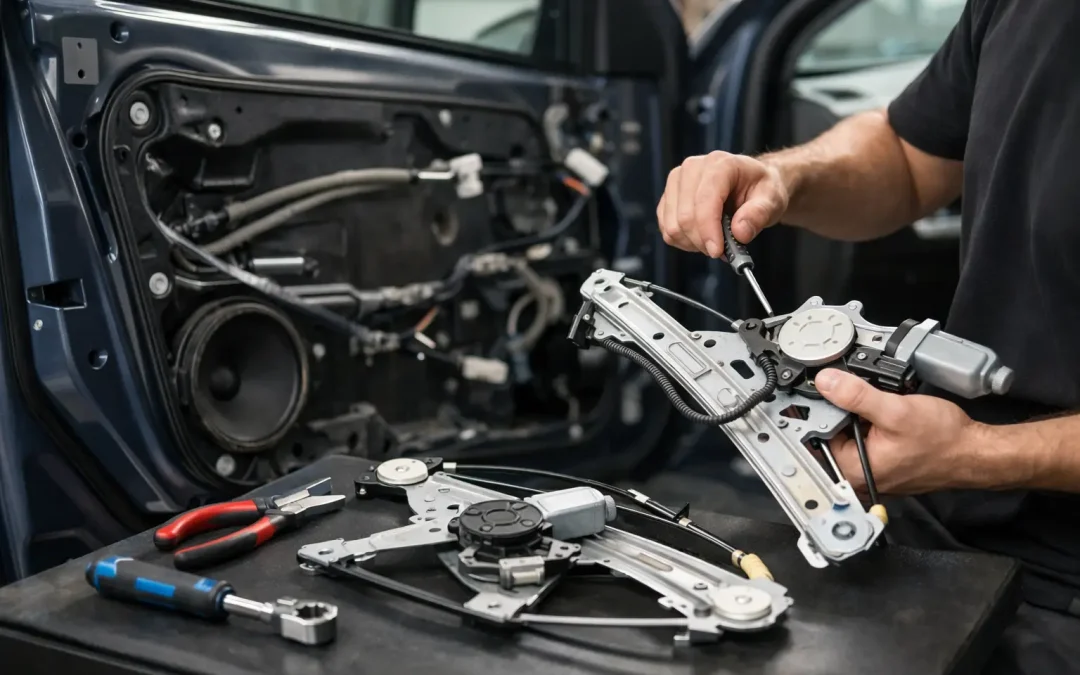
A power window that stops halfway down during a Humble summer storm is more than an inconvenience. It can leave your vehicle exposed to rain, heat, theft, and road noise. This car window regulator repair guide explains what usually fails, how to recognize the signs, and when a professional repair is the safer, more cost-effective choice.
What a Window Regulator Actually Does
The window regulator is the mechanical assembly inside your door that moves the glass up and down. On most modern vehicles, it works with an electric window motor, switches, wiring, guide channels, and mounting hardware. When you press the window switch, the motor turns and the regulator converts that movement into a controlled lift or drop of the glass.
There are two common regulator designs. Cable-style regulators use a cable and pulley system to move the glass. They are widely used but can fail when a cable frays, tangles, or slips off a pulley. Scissor-style regulators use crossing metal arms and gears. They are sturdy, but worn gears, pivots, or mounting points can still cause trouble over time.
The regulator does not work alone. A window can move poorly because of damaged glass, a weak motor, dirty or bent window channels, moisture inside the door, or an electrical issue. That is why a proper diagnosis matters before ordering parts or taking the door panel apart.
Signs Your Window Regulator May Be Failing
A bad regulator often gives a driver warning before it stops working completely. The clearest sign is a window that moves slowly, tilts to one side, binds in the channel, or stops before reaching the fully closed position. You may also hear clicking, grinding, popping, or cable-like scraping inside the door.
If you hear the motor running but the glass does not move, the regulator is a likely culprit. A broken cable or detached glass mount may allow the motor to operate without lifting the window. If the glass falls into the door or must be held up by hand, stop using the switch. Repeatedly trying to raise it can damage the motor, scratch the glass, or strain the door components further.
No sound at all when you press the switch points more toward a blown fuse, failed switch, wiring fault, or failed motor. On vehicles where several windows stop working at once, start with the fuse, master switch, or electrical system rather than assuming every regulator has failed.
A quick check before scheduling repair
With the ignition on, press the window switch while listening closely at the door. A humming or whirring sound with no glass movement often indicates a mechanical regulator issue. Watch the glass as it moves, too. If one edge rises faster than the other, the regulator or guide channel may be loose or damaged.
Do not force the glass by hand while another person runs the switch. Glass can crack under uneven pressure, and a regulator can pinch fingers unexpectedly. If the window is open and rain is approaching, protect the opening temporarily and arrange service as soon as possible.
Car Window Regulator Repair Guide: Repair or Replace?
Whether a regulator can be repaired depends on the part design and the source of failure. In some cases, a loose bolt, worn guide, detached glass clip, or minor obstruction can be corrected without replacing the complete assembly. Cleaning and lubricating dry window channels may also improve a slow-moving window when the regulator and motor are still in good condition.
More often, a failed cable-style regulator needs replacement. Once the cable has frayed, tangled, or come off its track, reinstalling it is rarely a dependable long-term solution. The same is true for cracked plastic pulleys, stripped gears, bent regulator arms, or corroded components. Replacing the assembly restores proper support for the glass and helps prevent a repeat failure.
The motor creates another decision point. If the motor is operating normally and the regulator has failed mechanically, replacing only the regulator can control the repair cost. If the motor is weak, intermittent, noisy, or has been strained by a jammed regulator, replacing the regulator and motor together may make more sense. The right answer depends on the vehicle, the parts available, and the condition found inside the door.
Why Regulator Work Is More Precise Than It Looks
Door-panel removal is only the beginning. Modern doors may contain side-impact components, vapor barriers, wiring connectors, door-lock cables, speakers, and airbags. The window glass must be supported correctly while the old regulator is removed. Improper handling can chip the glass edge, damage clips, tear a water barrier, or leave the window misaligned.
Correct alignment is especially important. A window that closes at the wrong angle can create wind noise, let water enter the door, wear out weatherstripping, or put extra stress on the new regulator. After installation, the glass should travel smoothly through its full range, seal evenly at the top, and stop without binding.
Some vehicles also require a window initialization procedure after power is disconnected or components are replaced. This process restores one-touch operation and anti-pinch protection. Skipping it may leave the window operating inconsistently or prevent automatic-up features from working as intended.
Water intrusion deserves attention
If a power window problem began after heavy rain, a car wash, or flooding, ask for the door to be inspected for moisture damage. A torn vapor barrier can allow water to reach switches, connectors, speakers, and the interior door panel. Replacing a regulator without correcting the water path can leave the underlying problem in place.
What a Professional Window Regulator Service Should Include
A quality repair starts with confirming the cause of the failure instead of replacing parts based on symptoms alone. The technician should test the switch, power supply, motor response, regulator movement, glass alignment, and window channels. This helps separate a mechanical failure from an electrical fault.
Once the repair is underway, the glass should be secured, the regulator installed with the correct hardware, and the track adjusted for smooth travel. The technician should then test the window repeatedly, verify the weather seal, and confirm that one-touch and anti-pinch functions work when equipped.
At NXT Auto Glass, the focus is not simply getting a window to move once. The goal is to restore secure operation, proper alignment, and a dependable seal so your vehicle is ready for daily driving again. For drivers in Humble and nearby Harris County communities, mobile service can also reduce the hassle of driving with a window stuck open or taped shut.
Can You Repair a Window Regulator Yourself?
A confident do-it-yourself owner with the right tools can replace some regulators, but the trade-off is time, fitment risk, and the possibility of causing damage inside the door. You may need trim tools, sockets, a drill for certain riveted assemblies, electrical test equipment, protective gloves, and a safe way to hold the glass in place.
Before starting, make sure the replacement part matches your vehicle’s year, make, model, trim, and door position. A front driver-side regulator may look similar to a rear passenger-side unit but have different mounting points, cable routing, or motor connections. Cheap, poorly fitting parts can also create alignment problems that are not obvious until the window begins binding again.
DIY repair is usually best reserved for straightforward mechanical failures on older vehicles. Professional service is the better choice when the glass has fallen, the door contains complex electronics, the motor may be involved, water damage is present, or you need the vehicle secured quickly.
How to Prevent Future Power Window Problems
You cannot prevent every regulator failure, especially as a vehicle ages, but a few habits reduce unnecessary strain. Keep window channels clear of dirt and debris, avoid repeatedly operating a frozen window, and do not slam the door while a window is partially open. If the glass starts moving slowly or crookedly, address it early rather than forcing it through several more cycles.
Pay attention after any door repair or glass replacement as well. A window that suddenly makes noise, leaves a gap at the top, or no longer performs one-touch movement should be checked before it becomes stuck open. Small alignment concerns are usually easier to correct before they damage the regulator or glass.
A failed window regulator does not have to turn into a larger problem. Prompt diagnosis, the right replacement decision, and careful alignment can get your window closing securely again – and let you get back to driving without worrying about the next rainstorm.