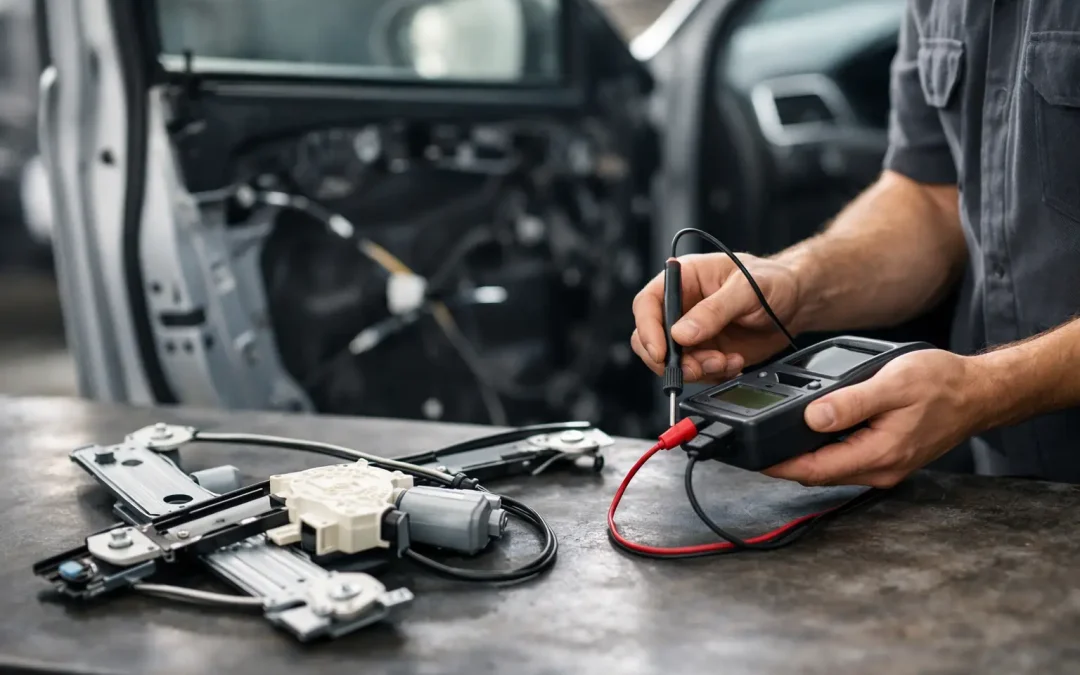
A power window that stops halfway, drops into the door, or makes a grinding sound is more than an everyday inconvenience. An open or poorly secured window can expose your vehicle to rain, theft, and road noise. Knowing how to test car window regulator problems can help you tell the difference between a simple electrical issue and a failed regulator that needs repair.
The regulator is the mechanical assembly inside the door that guides the glass up and down. It works with the window motor, switches, wiring, and tracks. Because several parts must work together, a window that will not move does not automatically mean the regulator is bad. A careful test helps avoid replacing the wrong part.
Start With the Symptoms
Before removing a door panel, pay attention to what the window does when you press the switch. The behavior often points you toward the likely problem.
If the glass moves slowly, tilts forward or backward, or needs help from your hand, the regulator, guides, or window tracks may be binding. Clicking, popping, cable-like snapping, or grinding from inside the door commonly indicates a damaged regulator cable, pulley, or gear.
If you hear the motor running but the glass does not move, the regulator is a strong suspect. On the other hand, if there is no sound at all, the problem may be a blown fuse, failed switch, wiring issue, or bad motor. A window that works from the driver’s master switch but not its own door switch is usually a switch issue, not a regulator failure.
Test the window from both the individual door switch and the driver’s control panel, if your vehicle has one. Also check whether the other power windows work. When several windows fail at once, start with the fuse, relay, power supply, or master switch instead of taking apart every door.
How to Test a Car Window Regulator Step by Step
A basic inspection can be done with simple hand tools, but door panels vary by vehicle. If you are not comfortable working around electrical connectors, side airbags, or fragile trim clips, professional diagnosis is the safer route.
Check the fuse and electrical supply first
Find the power-window fuse in the owner’s manual or fuse-box diagram. Remove it and inspect the metal strip inside. If it is broken or burned, replace it only with a fuse of the same amperage. A replacement fuse that blows again points to a short circuit or an overloaded component, and it should be diagnosed rather than repeatedly replaced.
If the fuse is good, turn the ignition to the accessory or run position and operate the affected switch. Listen closely at the door. A quiet door does not prove the regulator is good or bad, but it tells you electrical testing should come before mechanical disassembly.
Listen for motor activity
Press and hold the window switch in both directions while listening near the door panel. A steady humming sound, especially if the glass stays still, usually means the motor is receiving power but cannot move the regulator or glass.
A single click can mean the motor is trying to engage, but a worn gear, jammed regulator, or weak electrical connection is preventing movement. Grinding or crunching noises are more specific warning signs of a stripped gear or frayed cable. Do not keep holding the switch when you hear grinding. Continuing to force the system can damage the glass, motor, or wiring.
Inspect the glass movement and alignment
With the door closed, watch the top edge of the glass as it moves. The glass should travel smoothly in its channels and seal evenly at the top. A window that rises crookedly, stalls near the top, or falls inside the door may have come loose from the regulator clamps or slipped out of a guide.
You can gently support the glass with an open palm while operating the switch, but do not pull hard on it. If the window suddenly moves only when supported, the regulator may be weak or its cable may be failing. If the glass feels tight and will not budge, it could be stuck in a dry, dirty, or damaged run channel.
In humid Harris County weather, worn window channels and moisture inside a door can add resistance. That resistance may reveal an aging regulator, but cleaning or correcting the channel issue can sometimes prevent unnecessary strain on a replacement part.
Remove the door panel for a visual inspection
If the basic checks point to an internal mechanical problem, the next step is to inspect the regulator. Disconnect the negative battery cable before unplugging connectors or working near the door’s wiring. This is especially important on vehicles with side-impact airbags mounted in or near the door panel.
Remove screws, trim pieces, and clips carefully. Door panels can hide fasteners behind handles, armrests, and switch panels. Once the panel is off, peel back the water shield slowly. It must be resealed properly later to help keep moisture away from the interior and electrical components.
Look through the door’s service openings for loose bolts, broken plastic clips, a frayed cable, bent regulator arms, or a cable that has come off its pulley. Check that the glass is securely attached to the regulator clamps. A broken cable regulator often has loose cable loops or a tangled cable spool inside the door.
Test voltage at the window motor
A multimeter is the most reliable way to separate a motor or wiring problem from a regulator problem. With the motor connector accessible, test for voltage while someone presses the window switch. Most systems reverse polarity: power is sent one way to lower the window and reversed to raise it.
If the motor receives proper voltage in both directions but does not run, the motor is likely faulty. If it runs but the regulator does not move the glass, the regulator is likely damaged or disconnected. If there is no voltage at the motor, investigate the switch, wiring, connectors, fuse, relay, or body-control module before replacing mechanical parts.
This is where diagnosis matters. Many vehicles use a motor-and-regulator assembly, and replacing both may be practical when the motor is older or the assembly is designed as a unit. Still, replacing parts without confirming the fault can add cost without solving the issue.
Signs the Regulator Needs Replacement
A regulator should generally be replaced when its cable is broken or frayed, its arms are bent, its mounting points are damaged, or the glass repeatedly travels crookedly despite properly aligned tracks. It is also time for replacement when the motor runs but the regulator cannot lift or lower the glass.
A regulator may not be the cause when the window is simply slow because the rubber channels are dirty, dry, or swollen. Likewise, an intermittent window can come from a worn switch or a damaged wire in the flexible harness between the door and body. Testing power at the motor keeps those problems from being mistaken for a mechanical failure.
Safety Considerations During Testing
Window glass is heavier and sharper than it looks, particularly if it is chipped or has come loose from its mounts. Never leave a loose window unsupported inside the door. If the regulator has failed with the glass stuck down, secure the opening from weather and avoid driving at highway speeds until it is repaired.
Do not force the glass upward with excessive pressure. That can crack the glass, bend the new regulator, or damage the door frame. If the glass is partly raised and the regulator is removed, it must be held in place with appropriate temporary support before the assembly is disconnected.
Modern door systems can also include airbag wiring, speaker wiring, keyless-entry components, and anti-pinch window functions. After a repair, some vehicles need the power-window limits reset so one-touch operation and anti-pinch protection work correctly.
When Professional Power Window Repair Makes Sense
A do-it-yourself test is useful when you want clearer answers, but professional service is the better choice when the glass is loose, the door contains an airbag, wiring tests are needed, or the vehicle has suffered impact damage. The job can require panel-specific tools, secure glass support, precise alignment, and a quality replacement regulator that will hold up to daily use.
For drivers in Humble and nearby Harris County communities, NXT Auto Glass can inspect the window system, identify whether the fault is electrical or mechanical, and complete power window replacement with careful attention to glass alignment and safe operation. The goal is not just to make the window move again, but to make sure it closes securely, seals properly, and works when you need it.
A window problem rarely improves on its own. Testing it early and addressing the real cause can protect your vehicle interior, preserve security, and spare you from being caught in Texas rain with a window that will not close.