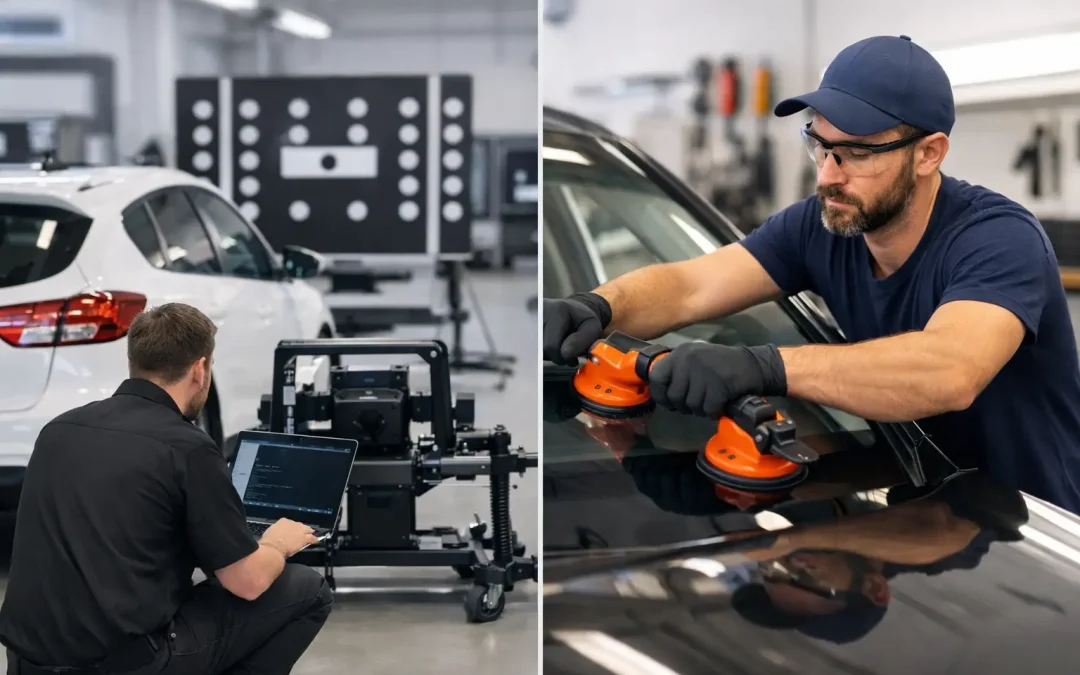
A windshield replacement can change more than the view from the driver’s seat. On many newer vehicles, the glass supports a forward-facing camera that helps with lane departure warnings, automatic emergency braking, adaptive cruise control, and more. Once that windshield comes out, the camera may need to be recalibrated before those safety features can be relied on again.
That raises a common question for drivers after glass damage: dealer calibration versus glass shop – where should the work be done? The best answer is not automatically the dealership or automatically the lowest quote. It is the provider with the correct equipment, current vehicle information, a controlled process, and the experience to verify that your vehicle’s driver-assistance systems are working as intended.
Why Windshield Calibration Is Necessary
Advanced driver-assistance systems, often called ADAS, use cameras, radar, and sensors to monitor the road and surrounding traffic. The forward-facing camera is commonly mounted near the rearview mirror, looking through a specific area of the windshield. Its position, angle, and relationship to the vehicle must be exact.
A new windshield can have the same shape as the original and still alter the camera’s reference point by a small amount. That small change matters. If the camera is not properly aimed, a lane warning may react too late, a forward-collision alert may be inaccurate, or a safety feature may disable itself and display a warning message.
Calibration tells the vehicle where its camera is after replacement or repair work. Depending on the make, model, and system, the procedure may be required after a windshield replacement, camera removal, collision repair, suspension work, wheel alignment, or replacement of certain ADAS components.
Not every windshield replacement requires calibration. Older vehicles and models without camera-based driver-assistance features may not need it. The right shop will identify the equipment on your specific vehicle instead of treating every car the same.
Dealer Calibration Versus Glass Shop: What Actually Differs?
The real difference is usually not the sign on the building. It is whether the provider can perform the manufacturer-required procedure correctly for your vehicle.
A dealership often has direct access to manufacturer diagnostic platforms, factory service information, and technicians who work on one brand every day. For some vehicles, especially newer models with highly restricted software or unusual calibration requirements, that access can be valuable. A dealer may also be the practical choice if the calibration cannot be completed outside its network or if another warranty-related repair is already being handled there.
A qualified auto glass shop brings a different advantage: the windshield installer and calibration technician understand the glass, camera bracket, moldings, adhesives, and installation conditions that affect the job from the beginning. When replacement and recalibration are coordinated by one experienced provider, there are fewer handoffs and less risk that a problem is passed from one shop to another.
A capable glass specialist may use OEM-compatible diagnostic tools, manufacturer procedures, calibration targets, and scan reports to complete the work. Many can perform both static and dynamic calibration, depending on what the vehicle requires. That can save time compared with replacing the glass at one location and scheduling calibration somewhere else days later.
The key phrase is qualified. Not every glass shop performs calibrations in-house, and not every shop that can clear a dashboard warning can complete a full ADAS calibration. Ask clear questions before authorizing the work.
Static and Dynamic Calibration Are Not Interchangeable
Static calibration is performed with the vehicle parked in a controlled setting. The technician places precisely measured targets at specific distances and heights, connects approved diagnostic equipment, and follows the vehicle’s calibration sequence. Lighting, floor level, tire condition, vehicle height, and target placement can all affect the result.
Dynamic calibration is completed while driving the vehicle under specified road conditions. The system learns or verifies camera alignment while the technician follows the manufacturer’s required speed, lane markings, traffic conditions, and route parameters. Some vehicles need dynamic calibration only. Others require static calibration, and some require both.
This is why a quick drive around the block is not automatically a calibration. The process must match the vehicle’s service information, and the result should be documented.
When the Dealership May Be the Better Choice
There are situations where sending a vehicle to the dealer makes sense. If a vehicle has a manufacturer-specific software lock, requires a programming update during calibration, has an active recall, or uses a system that an independent provider cannot support, dealer service may be necessary.
The dealership can also be helpful when calibration repeatedly fails after proper glass installation and inspection. At that point, the vehicle may have an unrelated fault code, damaged wiring, radar alignment issue, or module problem that needs brand-specific diagnosis.
That said, dealer service can mean a separate appointment, extra transportation planning, and a longer total repair timeline. The vehicle may also need to be transported or driven after the glass adhesive has cured. Cost can be higher, although pricing varies widely by vehicle and procedure.
A trustworthy glass shop should be comfortable saying when dealer involvement is the right next step. That is not a weakness. It is responsible service.
When a Glass Shop Is the Better Fit
For many drivers in Humble and across Harris County, a calibration-equipped auto glass shop is the more convenient choice after windshield damage. The technician can inspect the vehicle, install the proper windshield, verify the camera bracket and surrounding components, and handle the required calibration as part of one organized repair.
This approach is especially useful when time matters. A commuter with a growing windshield crack or a family dealing with a broken windshield does not need extra stops if the work can be handled correctly in one place. Mobile windshield replacement may also be available in appropriate conditions, although calibration itself may need a controlled shop environment for accuracy.
A specialized glass provider is also well positioned to catch installation details that affect calibration. The correct windshield part matters. So do the right acoustic features, heating elements, heads-up display compatibility, camera mounting area, moldings, and adhesive cure time. Installing inexpensive glass that does not match the vehicle’s required options can create problems before calibration even begins.
At NXT Auto Glass, the goal is to make that decision straightforward: inspect what your vehicle needs, explain the process in plain language, and complete the work with safety and precision at the center.
Questions to Ask Before You Choose
You do not need to become an ADAS expert to protect yourself. A few direct questions can tell you a great deal about the provider’s process.
Ask whether your year, make, and model requires calibration after windshield replacement. Ask whether the shop performs the calibration in-house or sends the vehicle elsewhere. If the answer is in-house, ask whether the procedure will be static, dynamic, or both according to manufacturer requirements.
Also ask whether the replacement glass matches your vehicle’s original equipment features, whether a pre-scan and post-scan will be performed, and whether you will receive documentation showing completed calibration results. A professional provider should answer clearly rather than make broad promises that every vehicle is the same.
Price deserves a conversation, too. The least expensive estimate may exclude calibration, use a windshield that lacks required options, or leave the final procedure to another shop. Compare complete repair plans, not just windshield prices. A clear estimate should explain what is included and what could change if pre-existing fault codes or unrelated vehicle issues are found.
Do Not Ignore Warning Lights After Replacement
A dashboard warning for lane assist, forward collision, camera systems, or automatic braking should not be dismissed as a minor inconvenience after new glass is installed. It may mean calibration has not been completed, the vehicle has detected a fault, or a separate repair is needed.
Likewise, do not assume the absence of a warning light proves calibration was unnecessary. Some systems may appear available even when their reference point is not correct. The manufacturer’s procedure and the vehicle’s equipment determine what should happen next.
Avoid driving aggressively or depending heavily on driver-assistance features until the required work is complete. ADAS is designed to support an attentive driver, not replace one, and it can only perform as well as its sensors are set up to perform.
Your windshield is part of your vehicle’s safety system, not simply a piece of glass. Choose the provider that can explain the calibration requirement, use the right process for your vehicle, and stand behind the work before you head back onto the road.